20070830

Beaujolais Nouveau will be more mature

PHOTO BY WILLIAM M. DOWD

Attention Beaujolais Nouveau revelers. Your infant wine will be a bit older this year.

The earlier harvesting of grapes in many parts of Europe, caused by unseasonable weather, is having a variety of effects on winemaking. In the case of Beaujolais Nouveau, the usual harvest begins around the start September. This year it already has begun, two weeks earlier. That, however, isn't expected to change the release date of the nouveau, traditionally the third Thursday of November -- the 15th, this year. That also is a time many fundraisers using the new wine are held around the world.

"It's the fifth time in my life that we have seen such a phenomenon. It's a bit exceptional," said Georges Duboeuf, head of one of the Burgundy region's biggest vineyards. He said the previous years were 1947, 1976, 2000 and 2003.

Duboef said the earlier harvest won't affect the quality of the new wine.

"For Beaujolais Nouveau, like many wines, if it's good at the start, it will be good at the end. It's not because the harvest is earlier that the wine will be more rounded or structured, or the taste will be different," he said. "Each vintage has its own characteristics."

To Dowd's Spirits Notebook latest entry.
To Dowd's Wine Notebook latest entry.
To Dowd's Brews Notebook latest entry.
To Dowd's Non-Alcohol Drinks Notebook latest entry.
To Dowd's Tasting Notes latest entry.
Back to Dowd On Drinks home page.

20070827

Europe may be forced to rethink its grapes

Many European grape growers are concerned that the strong possibility of an early harvest is looming.

Italy, which stretches into a number of growing seasons because of its length, may be the most affected. Grapes in some areas, such as around Rome, are ripening three weeks ahead of schedule. Other regions that normally harvest grapes in October are finding the fruit ready now.

The situation is being blamed on two separate heat waves that broke records across southeastern Europe in June and July.

Attilio Scienza, a professor of horticulture at the University of Milan with an expertise in vineyards, spoke with the Chicago Tribune about his advice on how to experiment with new varieties of grapes and his reluctance to blame the situation on global warming.

"There are records of early harvest across history," Scienza said, and those early harvests can have some effect on how growers look at the next season. If the pattern continues, he said, "this will likely change the variety of grapes in Europe. Growers will have to find grapes that fit the weather cycle."

However, the Italian Trade Commission's Web site isn't at all reticent about placing the blame.

"Unfortunately," it says, "early harvests are becoming progressively more common due to erratic weather patterns and rising temperatures caused by global warming.

"In Italy, the 2007 harvest comes even earlier than the record 2003 harvest. It is quite extraordinary to have two harvests like this in a short four-year span. 2007 weather patterns have been extreme across the continents with violent storms in Asia, exceptional flooding in England and extremely high temperatures in Europe this summer.

"Grapes were garnered a month early in many areas as the sweltering heat caused them to rapidly ripen. For example, Sicilian grape growers are now hastening to contract seasonal workers as their grapes now must be picked in early September instead of October. The grapes of the Northern sparkling wine regions of Veneto and Trentino also have been harvested approximately three weeks ahead of schedule."

In Hungary, Bulgaria and the Czech Republic, the same problem is taking place. In Slovenia, where wine exports have been steadily rising, the harvesting already has begun.

The head of Goriska Brda, the nation's farm advisory service, said the western region that ranks as the nation's leading wine grape area, will begin the harvest at the end of next week with Chardonnay, White Pinot and Sivi Pinot.

To Dowd's Spirits Notebook latest entry.
To Dowd's Wine Notebook latest entry.
To Dowd's Brews Notebook latest entry.
To Dowd's Non-Alcohol Drinks Notebook latest entry.
To Dowd's Tasting Notes latest entry.
Back to Dowd On Drinks home page.

20070825

Dr. Melfi's latest case, of wine

Celebrity-owned wines are commonplace. Think director Francis Ford Coppola, actor Fess Parker, musician Jerry Garcia, golfer Greg Norman, singer Olivia Newton-John and so forth.

And whatever you do, don't ignore Lorraine Bracco. On Sunday on Long Island, NY, she will unveil her ninth Bracco Wines label, this one called Rosato. It's a new rosé from Salento, Italy.

Bracco, whose film and TV career was most recently highlighted by her role as psychiatrist Dr. Janet Melfi on "The Sopranos," lives in Bridgehampton, Long Island.

Rosato is described as a medium-bodied rose made from the Negroamaro grape grown in vineyards located along the Adriatic and Ionian seas."

To Dowd's Spirits Notebook latest entry.
To Dowd's Wine Notebook latest entry.
To Dowd's Brews Notebook latest entry.
To Dowd's Non-Alcohol Drinks Notebook latest entry.
To Dowd's Tasting Notes latest entry.
Back to Dowd On Drinks home page.

Sippy box Bordeaux a big gamble

Boxed wine is nothing new on the American market, and many European countries are selling it as well. The thing is, most such wines are run-of-the-mill. Would they sell even better if they came from a high-level French producer?

Cordier Mestrezat Grands Crus (above), an upscale Bordeaux house for more than 100 years, is hoping that will be the case with its new offering, called Tandem. It's quite a departure from Cordier's top-shelf wines which can go for four figures.

Tandem is packaged in an 8.5-ounce carton containing red, white or rosé wines. Each carton has a straw with four holes, which is supposed to spray the wine into the consumer's mouth and, thus, mimic the sensation to drinking from a glass.

The winemaker is test marketing Tandem in 600 supermarkets in Belgium at $2.50 a carton. It will go on sale in France next year and abroad as well.

Cordier officials says they are trying to attract younger consumers in a market that is seeing a dropoff in sales of French wine in favor of American and South American imports and, indeed, a dropoff in wine sales in general as spirits gains market share.

"It is a product that can sell in stadiums, hotels and airlines," Vincent Bonhur, Cordier's head of marketing, said in a press release. "In France, the wine market is still very traditional, but in markets such as Canada, the U.K. and Northern Europe, this new format should be a hit."

To Dowd's Spirits Notebook latest entry.
To Dowd's Wine Notebook latest entry.
To Dowd's Brews Notebook latest entry.
To Dowd's Non-Alcohol Drinks Notebook latest entry.
To Dowd's Tasting Notes latest entry.
Back to Dowd On Drinks home page.

20070816

Washington wine groups split

For those who keep up with such things, Washington state's two wine agencies have split.

The Washington Wine Institute is breaking off from the Washington Wine Commission.

The Commission is a state agency responsible for promotion and development of the state's wine industry. It receives funding through fees levied on growers and producers. The Institute is a nonprofit formed in 1984, three years before the commission, to advocate on regulatory and legislative issues affecting the wine industry. Its members are mostly wine producers, but also include wine grape growers and wine associations.

The Commission will remain headquartered in Seattle and the Institute will move to Olympia to focus on its advocacy efforts.

To Dowd's Spirits Notebook latest entry.
To Dowd's Wine Notebook latest entry.
To Dowd's Brews Notebook latest entry.
To Dowd's Non-Alcohol Drinks Notebook latest entry.
To Dowd's Tasting Notes latest entry.
Back to Dowd On Drinks home page.

20070814

Upstarts top the New York field

PHOTOS BY WILLIAM M. DOWD
(Double-click to enlarge images)


Judges Rene Chazottes (left) of Newport Beach, CA, and Mike Dunne of Sacramento, CA.

NAPA, CA -- For the second time in five years, the 22nd annual New York Wine & Food Classic headed west to spread the gospel of Empire State wines.

Following its 2003 debut here at Copia: The American Center for Wine, Food & The Arts, the New York event returned for its annual competition for New York-only wines. Nearly 800 entries were judged by 24 experts from California (10), New York (6, including yours truly) and other states (6) as well as one each from Canada and the United Kingdom.

Rather than the usual suspects -- Herman J. Weimer or Konstantine Frank -- emerging on top, two relatively unknown entries took the top awards.

The Thirsty Owl Wine Co. from the Finger Lakes region won the Governor's Cup as best of show while winery of the year went to the Red Barn Winery of Central New York.

Thirsty Owl won with its 2006 Dry Riesling, the flagship wine of the Finger Lakes. En route to the Governor's Cup, the wine also was voted Best White and Best Dry Riesling. Thirsty Owl, one of the region's newest wineries, is located on Cayuga Lake on a tract of land that was part of a post-Revolutionary War grant awarded to Sgt. Florence Marony for his courageous service. The company was founded in 2002 by Jonathan Cupp.

Red Barn Winery is located in North Syracuse. It received a double gold (unanimous pick of the panel), two golds, one silver and two bronzes en route to its overall win.

"We maintain that many New York wines are now world-class in quality," said Jim Trezise, president of the New York Wine & Grape Foundation which sponsors and runs the competition. "The fact that we held this New York-only competition in Napa, and have three-fourths of all judges from places other than New York,, confirms our confidence in that belief. these are all very qualified judges, so we let the wines speak for themselves."

The event is organized by Teresa Knapp of the NYW&GF, and is open to all 239 New York wineries.


Peter Marks, senior director of wine and food at COPIA, and one of the judges.

The winners in each category of the competition:

Sparkling Wine: Swedish Hill Vineyards NV Spumante Blush.

White Wine: Thirsty Owl Wine Co. 2006 Dry Riesling.

Blush Wine: Barrington Cellars 2006 Buzzard's Blush.

Red Wine: Pindar Vineyards 2005 Cabernet Franc.

Dessert Wine: Mazza Chautauqua Cellars 2005 Ice Wine of Vidal Blanc.

Specialty Wine: Red Barn Winery 2006 Raspberry Wine.

The best-of-class winners:

Vinifera Sparkling: Osprey's DFominion Vineyards 2002 Rose de Noir.

Other Sparkling: Swedish Hill Vineyards NV Spumante Blush.

Dry Riesling: Thirsty Owl Wine Co. 2006 Dry Riesling.

Semi-Dry Riesling: Rivendell Winery 2006 Soho Cellars Johannisberg Riesling.

Oaked Chardonnay: econic Bay Winery 2005 La Barrique Chardonnay.

Unoaked Chardonay: Cayuga Ridge Estate Winery 2006 Chardonnay.

Pinot Gris: Hunt Country Vineyards 2006 Pinot Gris.

Pinot Blanc: Glenora Wine Cellars 2006 Pinot Blanc.

Gewurztraminer: Standing Stone Vineyard 2006 Gewurztraminer.

Hybrid White Blend: Bloomer Creek Vineyards 2006 Reserve White.

Vignoles: Anthony Road Wine Co. 2006 Vignoles.

Vidal Blanc: Long Point Winery 2006 Vidal Blanc.

• Cayuga White: McGregor Vineyard Winery 2006 Cayuga White.

Other White: Penguin Bay Winery 2006 Valvin Muscat.

Other Blush: Barrington cellars 2006 Buzzard's Blush.

• Catawba: Hazlitt 1852 Vineyards Cabin Fever.

Pinot Noir: Six Mile Creek Vineyard 2005 Pinot Noir.

Cabernet Franc: Pinda Vineyards 2005 Cabernet Franc.

Merlot: Bedell Cellars 2005 Merlot.

Vinifera Red Blend: Osprey's Dominion Vineyards 2002 Flight Meritage.

Native Red Blend: Fox Run Vineyards NV Fox Trot Red.

Late Harvest: Swedish Hill Vineyards 2005 Late Harvest Vignoles.

Ice Wine: Mazza Chautaqua Cellars 2005 Ice Wine of Vidal Blanc.

Port: Red Barn Winery 2005 Pauley's Port.

Mead: Torrey Ridge Scarlet Red.

Fruit Wine: Red Barn Winery 2006 Raspberry Wine.


Linda Lawry (left) of New York City and Ann Miller of Rolla, MO, are intent on their judging.

To Dowd's Spirits Notebook latest entry.
To Dowd's Wine Notebook latest entry.
To Dowd's Brews Notebook latest entry.
To Dowd's Non-Alcohol Drinks Notebook latest entry.
To Dowd's Tasting Notes latest entry.
Back to Dowd On Drinks home page.

Missouri '07 vintage will be very special

Psst. Want to buy a one-of-a-kind wine, cheap? Think Missouri.

In a year in which grape industry experts on both the east and west coasts are forecasting bumper crops, Missouri is facing a year without precedent.

A prolonged warm period in late winter coaxed grapes to grow too soon, only to be hit with a prolonged cold snap. That left Missouri and its 72 wineries -- double the number of just a decade ago -- in a precarious financial position,

While late-opening buds such as Norton and Vignoles survived the freeze to some extent and can provide a Missouri base for the '07 vintage, the Chardonel, Concord, Catawba and Cayuga White grapes were devastated and such varieties as Chambourcin, Seyval and Vidal are in scarce supply.

So, why would this misfortune lead to a special status for '07 wines? Glad you asked.

With 95% of the wine grape crop destroyed, Missouri will have to take extraordinary measures to keep its little industry afloat. I discussed the possibilities with Ann Miller, a consultant for the Missouri Wine & Grape Board and a veteran wine judge, while we were in Napa, Calif., last week doing a competition judging together.

"We're going to find a lot of the regulations changed for this year,'' she said. "The rules on buying and using grapes from out of state are going to have to be modified just to get any sort of 2007 vintage in the bottle and out to market.

"I don't know what the final decision will be on what we'll have to say on the labels -- probably something to show this was an unusual year and the grapes came from outside the state -- but I suppose it will have to be made very clear.''

Whatever the outcome, any Missouri wine bearing a 2007 vintage on the label will be a unique product, in the truest sense of the word. And, considering that most Missouri wines are under $25 anyway, whatever you invest in one will buy you a very special product at a very reasonable price.

The crop disaster is a particular shame since Missouri wines were beginning to come up big in top-flight competitions and in the right publications. If you plan to go online to check out potential Missouri wine purchases, consider the following recent happenings.

Golf Connoisseur Magazine selected Stone Hill Winery's Norton -- rich with black currant flavor -- as one of its "Delectable Dozen,'' 12 wines it deems excellent value.

St. James Winery won the 2007 Spiegelau Gold Medal Champion award from the Tasters Guild International wine competition for earning more double gold and gold medal points than any other winery in the competition. At the Riverside (CA) International, St. James earned unanimous golds for its Country White and '05 Late Harvest Chardonel plus single golds for its Sparkling Blush, Chardonel Port, Strawberry and Blackberry won gold. Silver went to Augusta Winery '06 Seyval, '04 Norton, '06 Chambourcin, Mt. Pleasant '05 Claret, St. James '03 Norton, '05 Chardonel, '06 Vintner's Select Vignoles, Country
Red, Velvet White, Riesling and Friendship School White.

At the Finger Lakes (NY) International Wine Competition, Crown Valley Winery '05 Sweet Riesling and St. James Winery Strawberry earned gold while silver went to Cave Vineyard '05 Chardonel, Stone Hill Winery '05 Chardonel, and '04 Port, Oak Glenn Vidal Blanc, Les Bourgeois '05 LaBelle, Crown Valley '04 Meritage, Mt. Pleasant '01 Vintage Port and St. James Winery Country White, Velvet White, '05 Vintner's Select Vignoles, Muscatto, Riesling and Velvet Red.

At the San Diego Wine Competition, Stone Hill Winery Golden Spumante won best in class and won golds for its '05 Vignoles and '04 Norton. St. James Winery Pink Catawba also won a gold.

To Dowd's Spirits Notebook latest entry.
To Dowd's Wine Notebook latest entry.
To Dowd's Brews Notebook latest entry.
To Dowd's Non-Alcohol Drinks Notebook latest entry.
To Dowd's Tasting Notes latest entry.
Back to Dowd On Drinks home page.

20070813

Home winemaker's dream

If you've ever wanted to make wine but didn't want to use up precious basement space, you'll envy folks within reach of a full-service make-your-own facility in New Jersey.

The Home News Tribune has a fascinating story about The Grape Escape, a wine school that operates from a 5,000-square-foot warehouse, offering "a hands-on approach through the entire process — from the crushing of grapes, which are shipped in, to bottling."

To Dowd's Spirits Notebook latest entry.
To Dowd's Wine Notebook latest entry.
To Dowd's Brews Notebook latest entry.
To Dowd's Non-Alcohol Drinks Notebook latest entry.
To Dowd's Tasting Notes latest entry.
Back to Dowd On Drinks home page.

20070802

NY wine judging shipped to Napa again

For the second time, the New York Wine & Food Classic which decides the best wines made in the Empire State will be held in California.

Judges will begin arriving from across the U.S. and U.K. on Monday for the two-day event being hosted Aug. 7-8 at COPIA: The American Center for Wine, Food & The Arts, located in Napa. The same site was used for the competition in 2003.

The idea behind holding the judging of New York wines somewhere other than in New York State was to expose more labels to West Coast judges, sommeliers and wine writers, according to the New York Wine & Grape Foundation which conducts the event.

To Dowd's Spirits Notebook latest entry.
To Dowd's Wine Notebook latest entry.
To Dowd's Brews Notebook latest entry.
To Dowd's Non-Alcohol Drinks Notebook latest entry.
To Dowd's Tasting Notes latest entry.
Back to Dowd On Drinks home page.

20070727

Bordeaux 'garage winery' movement hits Napa

ARTIST'S RENDERING

Ready for the California version of "Les Garagistes"?

Most people probably don't know because they don't know the French term. To explain, the term was coined in the 1970s by Belgians Marcel and Gerard Thienpont who purchased land in Bordeaux and established Chateau Le Pin, the concept of "garage wines."

The movement, which allows smalltime winemakers to work in boutique settings at affordable prices, grew in the early '90s when St. Emilion's Chateau de Valandraud was created in Bordeaux.

Now, a self-contained "artisinal village" of 12 spaces custom built for limited-production wineries has been created in Napa Valley's American Canyon. It will offer spaces ranging from 3,500 to 6,500 square feet, located in four buildings surrounding a 16,000-square-foot courtyard. The complex is projected to open by August 2009.

Founders John Hawkins and Tony Cartlidge explain their idea this way:

"The garagiste winemaker, intimately involved in every step of the process, is practically bound to make a wine which reflects his or her personality, just as a painting reflects the personality of the painter. It can be wine made to your own standards, with passion coming before profit."

In other words, it is "for winemakers and owners of limited production, high quality wine brands who are dedicated to their craft and wish to affordably assume more control over winemaking and promotional activities."

To Dowd's Spirits Notebook latest entry.
To Dowd's Wine Notebook latest entry.
To Dowd's Brews Notebook latest entry.
To Dowd's Non-Alcohol Drinks Notebook latest entry.
To Dowd's Tasting Notes latest entry.
Back to Dowd On Drinks home page.

20070717

Ranch Winery big on storage

Sometimes you have to do more than just make wine to succeed in the wine business.

Take Joel Gott (right). He had entered into a partnership with Trinchero to produce his Three Thieves wines, then wound up heading a group that purchased the Trinchero family's Chicken Ranch Zinfandel Road winery in St. Helena, CA.

That led to creation of The Ranch Winery, a new custom crush facility under development. Its first stage is a 33,000 square-foot barrel-storage room Gott sees as helping meet "a big need for barrel storage in Napa Valley."

He plans to be one of his own major customers, storing Joel Gott Wines, in the open room that can hold 10,000 to 15,000 barrels. The company plans to build a second, similar storage area as demand grows.

The storage room and the other plans for the huge facility are being supervised by Mark Beringer, The Ranch's general manager and head of winemaking operations, and formerly winemaker at Duckhorn Vineyards.

The Ranch eventually will occupy a 120,000 square-foot casegoods storage facility. Gott is leasing part of the operation back to the Trincheros.

According to Wines & Vines magazine:

"Gott is providing plenty of capacity for small start-ups, though he also expects to serve existing wineries and handle overflow from big wineries, too. Many of them have to process grapes out of county because of lack of capacity in Napa Valley. ... The Ranch is now installing 22 fermenters ranging from one to five tons in size, and expects to crush 500 tons there this year. There are plans to have 60 small fermenters and crush 2,000 tons in 2008, 5,000 in 2009, then 20,000 tons -- 1 million gallons -- in 2010. After that, the partners take over the whole facility, which has six million gallons of bulk storage and one million in fermentation tanks, as well as the presses and other equipment needed for this volume."

To Dowd's Spirits Notebook latest entry.
To Dowd's Wine Notebook latest entry.
To Dowd's Brews Notebook latest entry.
To Dowd's Non-Alcohol Drinks Notebook latest entry.
To Dowd's Tasting Notes latest entry.
Back to Dowd On Drinks home page.

20070710

Letters: Is my '85 Bourgogne Pinot worth anything?

Dear William:

I was wondering if you could tell me a little about the following wine that I have had laying around for some time. All the information on the bottle is as follows:

1985 Produit de France
Bourgogne Pinot
Appellation Bourgogne Pinot Controlee
Mis en bouteille par
Picard Pere & Fils
Chagny (s.-&-l.)

As you can see it is a little old. What do you think? Is it worth holding on to, or is it worth nothing? Any advice greatly received. Many thanks.

-- Adam Sutton

Dear Adam:

Your question sent me on a merry chase. Tracking down much information on a 22-year-old wine is spotty at best, given the explosion in available wines over the past two decades and how fast wine merchants shuffle their stock and get on to the Next Great Thing.

I can tell you unequivocally that Picard Pere & Fils is a respected Burgundian wine house, and the Bourgogne Pinots of this century have been generally of good quality. But I have my doubts about anything that has been around this long unless it was stored in perfect conditions as far as temperature and light are concerned.

Why? Well, the pinot noir grape is genetically unstable and susceptible to just about every vine disease that comes along. That sometimes affects its storability even if the wine is OK when young. Color retention is a problem as well.

You may very well have a gem on your hands, but the only way to really know is to open it and try it. Then, of course, you are left with an open bottle of wine and no particular value except for the taste of the moment. If you want to learn more about the fussy grape, I suggest checking in here with the Professional Friends of Wine.

To Dowd's Spirits Notebook latest entry.
To Dowd's Wine Notebook latest entry.
To Dowd's Brews Notebook latest entry.
To Dowd's Non-Alcohol Drinks Notebook latest entry.
To Dowd's Tasting Notes latest entry.
Back to Dowd On Drinks home page.

20070705

Wisconsin wants to tangle wine sales

While some states are untangling their cobweb of wine sales rules, Wisconsin may be going the other way.

A proposal slipped into the state budget document this week would require all wineries to go through a distributor when selling wine. That would effectively prohibit wineries from shipping directly to stores and virtually end direct mailing of wine to residences. It also might prevent wineries from selling their own products on their premises.

The proposal comes in response to a 2005 U.S. Supreme Court decision that all wineries should be on a level playing field, but some area wineries say the proposal will end up doing more harm than good.

The budget, along with the proposed wine law, was passed Tuesday in the Wisconsin State Senate. The Assembly version of the bill is scheduled to come up for a vote next week.

To Dowd's Spirits Notebook latest entry.
To Dowd's Wine Notebook latest entry.
To Dowd's Brews Notebook latest entry.
To Dowd's Non-Alcohol Drinks Notebook latest entry.
To Dowd's Tasting Notes latest entry.
Back to Dowd On Drinks home page.

Draining Europe's 'wine lake' a desperate idea

Sometimes widespread panic can last more than just a moment. In Europe, it seemingly is becoming a way of life for the alcoholic beverage industry.

Member nations of the European Union have been working themselves into a lather trying to redefine and re-regulate everything from niche products to entire swaths of the industry, such as Scotch whisky and wine. A September vote on a whole package of changes is scheduled by the European Parliament, which is creating enough tension as it is without the latest proposal.

The EP, headquartered in Brussels, Belgium, has proposed the destruction of hundreds of thousands of acres of European vineyards in an attempt to drain the "wine lake" and reconquer markets lost to non-European competitors such as the U.S., South America and Australia.

The European Union's annual "wine lake" of unsold wines is equivalent to about 1.7 billion standard-size bottles. The Parliament is proposing to pay producers of unsaleable wines to tear up their vines and, beginning in 2013, lift individual nations' restrictions to encourage wine-grape growers to shift to types of wine more in demand from consumers.

Part of the EU budget for supporting the wine industry would be shifted to a campaign to promote European wines on the international market. The distillation of surplus wine into industrial alcohol or disinfectants -- which costs about $680 million a year -- would end in 2009.

Mariann Fischer Boel, the European commissioner for agriculture and rural development, said the proposal would "boost competition, drain the infamous wine lakes and make things more simple. ... Until now we have been spending in an inefficient and indefensible way."

Some wine producers' organizations in France and elsewhere object to the plan, labeling it a "betrayal" of traditional European winemaking traditions to market forces and "ultra-capitalism."

According to the UK newspaper The Independent, "Much of the French, Spanish and Italian wine industry is already willing, in some cases eager, to take this approach. But there are fierce divisions between, and even within, wine-growing regions. The ban on the sugaring of wine would, for example, be very popular with southern French growers and disastrous for producers of cheaper red wine in Bordeaux.

"How much, and when, the EU plan would affect wine drinkers is unclear. The proposals will be fiercely opposed by some governments in the EU council of ministers. Much will finally depend on decisions still to be taken at national and regional level on the future of wine-making in Europe."

Despite a falloff in consumer demand in France, Italy and elsewhere, particularly among younger people, Europeans drink 60% of the world's wine. France, Italy and Spain are the EU's and the world's top producers by volume, but Europeans increasingly are drinking wine from beyond the EU. In 2005, the last year for which comp;ete figures are available, exports just barely outpaced imports.

To Dowd's Spirits Notebook latest entry.
To Dowd's Wine Notebook latest entry.
To Dowd's Brews Notebook latest entry.
To Dowd's Non-Alcohol Drinks Notebook latest entry.
To Dowd's Tasting Notes latest entry.
Back to Dowd On Drinks home page.

20070628

Two-Buck Chuck astounds wine judges

Some people love the idea, some competitors despise it. In any scenario, Charles Shaw Winery's inexpensive wines cause ripples in the wine world.

The latest ripple came in the California State Fair Commercial Wine Competition in Sacramento, where his 2005 chardonnay that is made by Bronco Wine Co. and retails for $1.99 a bottle -- thus the nickname "Two-Buck Chuck" -- was named "Best Chardonnay from California."

Chief judge G.M. Pucilowski said, “Since we judge all wines totally by variety, without different brackets for price, this double-gold achievement by the Bronco winemakers is astounding.”

Charles Shaw Winery is a brand owned by the Franzia family which has made wine in California for more than a century. Neither has any relationship to Franzia brand boxed wine.

Bronco president Fred Franzia said, “The customer has responded to our great values and now the judges to our quality. This is why we’re in business: to put the best wine possible on the customers’ tables at a reasonable price. I just wish some other retailers and restaurateurs had the courage and good sense to make these super-value wines available to more American wine consumers.”

Complete results of the competition are scheduled to be announced on July 12.

To Dowd's Spirits Notebook latest entry.
To Dowd's Wine Notebook latest entry.
To Dowd's Brews Notebook latest entry.
To Dowd's Non-Alcohol Drinks Notebook latest entry.
To Dowd's Tasting Notes latest entry.
Back to Dowd On Drinks home page.

20070622

Letters: What about us Kentucky wine buyers?

Hey Bill:

If it is now legal to ship wine to Kentucky (as of 2007), why are none of the wineries aware of it? Is the law officially changed?

Thanks for your help.

-- Lisa Will in Kentucky

Dear Lisa:

Yes, the law changed on Jan. 1 of this year. Any non-Kentucky wineries that are allowed by their own states to ship wines elsewhere can ship them to Kentucky.

If you want to direct anyone to an explanation, they can try this one.

To Dowd's Spirits Notebook latest entry.
To Dowd's Wine Notebook latest entry.
To Dowd's Brews Notebook latest entry.
To Dowd's Non-Alcohol Drinks Notebook latest entry.
To Dowd's Tasting Notes latest entry.
Back to Dowd On Drinks home page.

Is NY going too wild for wine centers?

PHOTO BY WILLIAM M. DOWD
(Double-click to enlarge image.)

One year ago, a $7.5 million wine center designed as a tourism and educational facility was opened in the Finger Lakes city of Canandaigua, NY.

Now, a mere 65 miles away in downtown Ithaca, another entity called the Finger Lakes Wine Center will be created to promote the region's wine industry, primarily to tourists, if Gov. Eliot Spitzer signs a bill passed by the Legislature. There already is $100,000 in the state budget to get it going.

It's all part of New York State's typically convoluted efforts to get something right. The New York Wine & Culinary Center in Canandaigua got $2 million in state taxpayer money to get rolling and has been drawing nice crowds for tours and events since opening last June, thanks to the tireless efforts of its staff and that of the New York Wine & Grape Foundation, which is headquartered at the Center on the shore of Canandaigua Lake.

And, the Foundation recently revealed it is using a $44,500 Empire State Development Grant to explore the feasibility of building a similar, albeit smaller, wine center in the lower Hudson Valley.

Did I mention there already is something called the Finger Lakes Wine Center, and New York owns it?

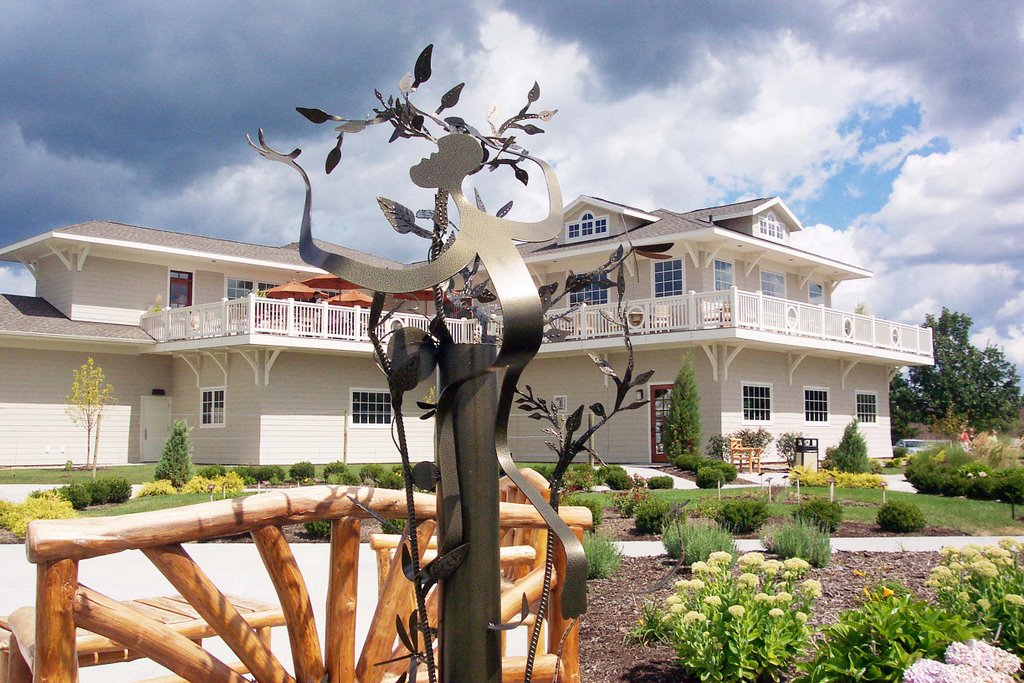
It is located at Sonnenberg Gardens and Mansion State Historic Park, just two miles from Canandaigua Lake, and is part of the state parks system. It operates from mid-May to mid-October, offering tastings, retail wine sales and special events. Its Italian Garden is seen here.

One would think three wine centers -- one of which is owned by the state, and all of which get taxpayer money -- plus all the wine trail organizations throughout the state would be sufficient if efforts were coordinated and properly channeled. Why, then, yet another wine center?

The legislation was sponsored in the Assembly by Barbara Lifton, the Democrat who represents Ithaca. Her formal language for the project reads thus:

"The bill will provide authorization for the Finger Lakes Wine Center, a not for profit corporation, to operate as a tourist oriented wine center dedicated to celebrating winemaking and the wines of the Finger Lakes and New York State. The Wine Center will serve as a resource for the regional tour information and provide educational opportunities that include winemaking demonstrations and classes. It will offer the opportunities for visitors to purchase New York state wine and serve as a venue to host events. It will also engage visitors with interactive exhibits. The Center also plans to hold classes in cooperation with participating wineries, local wine experts, members of the Cornell University community from the Cornell Hotel School and the College of Agriculture and Life Sciences and the New York Wine and Culinary Center. The Center also plans to make the Center available for public functions and events such as wedding receptions and business meetings."

That is pretty much the same mission statement the New York Wine & Culinary Center in Canandaigua already is carrying out, except that it deals more with Rochester Institute of Technology than Cornell.

The Ithaca project took Jim Trezise, president of the Wine & Grape Foundation, by surprise.

"I hadn't even heard about this Ithaca project until a few weeks ago when Alexa (Gifford, executive director of the Wine & Culinary Center) got wind of it and mentioned it to me. It has no connection at all with us or anything we're doing,'' Trezise told me.

Sen. George H. Winner Jr. (R-C, Elmira), a backer of the Senate version of the bill, explained the project in a much more parochial pronouncement, saying, "The wine industry is a mainstay of the culture and economy of the Finger Lakes. Anything we can do to further promote it and help it grow is a good investment for the future success of our region.''

Even if, apparently, it splinters the efforts.

To Dowd's Spirits Notebook latest entry.
To Dowd's Wine Notebook latest entry.
To Dowd's Brews Notebook latest entry.
To Dowd's Non-Alcohol Drinks Notebook latest entry.
To Dowd's Tasting Notes latest entry.
Back to Dowd On Drinks home page.

20070617

Wining and dining will get easier in Montana

Having a glass of wine with your restaurant meal hasn't been a snap to get in Montana. There are only 304 cabaret beer-and-wine licenses available in the entire state.

That, however, is about to change. The state legislature has created 165 new cabaret licenses. They differ from conventional all-beverage and beer and wine licenses by not allowing business owners to put in electronic gambling machines.

How great is consumer demand for such options? Mike Hampton, owner of Bullman's Wood Fired Pizza in Helena, told the Helena Independent Record, "We probably get 20 people a day that ask if we have beer. Some will leave (after learning the restaurant can’t sell beer), some, not a lot of people, will take the pizza home. Some will eat here and grumble.”

To qualify, a restaurant may not have a sit-down bar, and can serve beer and wine only to people eating meals at tables. At least 65% of the restaurant’s income must come from food, and it can be open only from 11 a.m. to 11 p.m. daily. People must apply by July 6. If a city has more restaurant applications than available licenses, a lottery will be held in late July.

If you're traveling through Montana, here's a checklist of where the additional licenses will be awarded, according to the Liquor Control Division, Montana Department of Revenue:

Billings: 21 current restaurant beer and wine licenses and will get 21 more after July 1 for a total of 42.
Bozeman: 14 current licenses, 10 new licenses after July 1 for a total of 24.
Butte: 10 current licenses, although only one is being used, 10 new licenses after July 1 for a total of 20.
Great Falls: 16 current licenses, 16 more after July 1 for a total of 32.
Helena: 10 current licenses, eight more after July 1 for a total of 18.
Kalispell: 11 current licenses, 10 more after July 1 for a total of 21.
Missoula: 17 licenses now (although it should be 14), 11 more after July 1 for a total of 28. Missoula has more licenses than it should because the allocations were based on census estimates and have been adjusted for the actual census.
Whitefish: 10 licenses now, eight more after July 1 for a total of 18.

Montana, incidentally, has four wineries: Mission Mountain, Lake Missoula, Lolo Peak and Trail Creek. Mission Mountain's Monster Red 2004 was awarded a gold medal in this year's Tasters Guild International Wine Judging.

As the winery's whimsical Web site explains the wine: "Once again we have proven that some of the best wines in the world come from our unique little winery on the west shore of Flathead Lake in Montana. Monster Red is the Flathead Lake Monster’s favorite red wine when enjoying stray cattle, wild game and buffalo."

To Dowd's Spirits Notebook latest entry.
To Dowd's Wine Notebook latest entry.
To Dowd's Brews Notebook latest entry.
To Dowd's Non-Alcohol Drinks Notebook latest entry.
To Dowd's Tasting Notes latest entry.
Back to Dowd On Drinks home page.

20070616

Floods smack Aussie wine region

The Australian wine industry has been bedviled in recent years by drought, brushfires, unseasonable rain, locusts and overabundant grape crops that have helped push down prices.

Add flooding to the list.

Last weekend, the large wine region north of Sydney known as Hunter Valley was hit by its worst flooding in 35 years.

Storms dumped about a foot of rain on New South Wales in the grape-growing region that already ranks as the wettest in the country. Nine people died in the floods.

"We had more than 200mm [8 inches] on Friday night alone," Phil Ryan, McWilliam's winemaker of 30 years, told WineSpectator.com. "I've never seen the rain gauge that full before."

The only upbeat note is, as Ken Bray, chairman of the Hunter Valley Vineyard Association viticultural committee, noted, "The vines were in dormancy, with few or no leaves, so there was not a lot of damage."

Among the worst-hit vineyards was De Bortoli's 32-acre plot of Sémillon.

"The entire vineyard was under [4 to 6 feet] of water," site manager Scott Harrington told reporters. "In one section it carved a big rut some 3 or 4 feet deep. That's quite a significant hole."

To Dowd's Spirits Notebook latest entry.
To Dowd's Wine Notebook latest entry.
To Dowd's Brews Notebook latest entry.
To Dowd's Non-Alcohol Drinks Notebook latest entry.
To Dowd's Tasting Notes latest entry.
Back to Dowd On Drinks home page.

At Hyatts, the house is on the wine

The house wine at Hyatt Hotels & Resorts now is the house wine.

Canvas, a new signature wine brand, has been developed in partnership with Folio Fine Wine Partners, a Napa Valley company owned by the Michael Mondavi family. It was unveiled this week at a tasting hosted by Mondavi at the Grand Hyatt New York.

The wine will be offered in cabernet sauvignon 2004, merlot 2005 and chardonnay 2005 styles. The varietals now are available at restaurants, bars and in-room dining at all Hyatt, Grand Hyatt, Hyatt Regency and Hyatt Resorts in the United States. Hyatt Place and Hyatt Summerfield Suites properties will begin serving Canvas wines later this year.

To Dowd's Spirits Notebook latest entry.
To Dowd's Wine Notebook latest entry.
To Dowd's Brews Notebook latest entry.
To Dowd's Non-Alcohol Drinks Notebook latest entry.
To Dowd's Tasting Notes latest entry.
Back to Dowd On Drinks home page.